
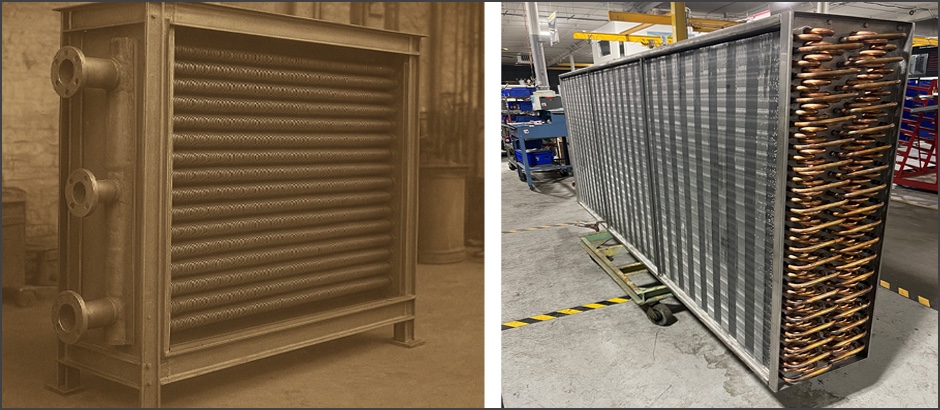
The story of modern comfort cooling and heating begins well over a century ago, even before Caesar and Angelo Marlo started building heating and cooling in their family’s St. Louis garage in 1925. Long before today’s advanced, energy-efficient HVAC systems, engineers and inventors were experimenting with ways to move heat – and the humble coil has been at the center of that journey from the very beginning.
Early Days of Heating: Pipes, Radiators, and Steam
In the late 1800s and early 1900s, heating for large buildings was primarily delivered through steam radiators and hot water pipes. These systems relied on metal’s ability to transfer heat from steam or hot water into the air, creating the earliest examples of heat transfer surfaces. While effective, these setups were bulky, inefficient, and difficult to scale for growing industrial and commercial needs.
The Birth of Mechanical Cooling
The turning point came in the early 1900s with Willis Carrier’s invention of modern air conditioning. To cool large spaces, engineers needed surfaces that could remove heat from air streams. This led to the first versions of today’s finned tube coils. Pipes carrying chilled water or refrigerant were paired with metal fins to increase the surface area and improve heat transfer. By the 1930s and 1940s, cooling coils were becoming a standard component in large building systems.
Marlo’s Distinct Contributions to the Industry
Since the Marlo brothers began building heating and cooling coils in the 1920s, Marlo Coil has been a true leader in the commercial and industrial coil industry. The company began by supplying coils to businesses in the St. Louis area, but developed a specialty for designing and building coils for U.S. Navy vessels during World War II – an expertise we continue to build on to this days.
In the 1950s, Marlo once again provided needed innovation to the industry by developing oil-cooling technology for diesel generators, which were used in small power stations as electrification spread across the United States. Read more about Marlo’s 100-year history.
Post-War Expansion and Standardization
After World War II, rapid urbanization and the construction boom fueled widespread demand for centralized heating and cooling. Coils became more standardized in design, with copper tubes and aluminum fins becoming the most common construction materials. This period also saw the growth of specialized coil manufacturers who refined designs for higher efficiency, easier installation, and improved durability.
With the growth of manufacturing, the use of coils expanded from comfort heating and cooling to process heating and process cooling for all types of industries. From manufacturing processes in automotive, aerospace, pharmaceuticals, food, semiconductors, and many others, specialized coils were needed to drive efficiency and product quality in these manufacturing processes.
The Rise of Customization
By the 1970s and 1980s, energy crises and evolving building designs shifted the focus to energy efficiency. Coil design evolved to include more precise engineering: varying fin density, tube diameters, and material selection based on the individual application. Engineers demanded solutions tailored to specific industries, from hospitals with sterile environments to manufacturing plants with harsh, corrosive conditions. This era marked the beginning of custom-engineered coils designed for performance in unique environments.
Marlo once again adapted to the changing needs of the industry, leading the charge in the move to customization. Today, we continue to be a custom coil manufacturer, designing and building each coil to meet specific needs and challenges. This involves the use of a wide range of materials, such as stainless steel, copper nickel and black iron – in addition to standard metals like copper and aluminum. Learn more about material selection.
Modern Era: High Performance and Sustainability
Today, commercial heating and cooling coils are highly engineered components that balance performance, durability, and energy efficiency. Advanced materials and special coatings are used to extend coil life in demanding applications. Precision, automated manufacturing and digital selection tools allow engineers to create coils that maximize airflow and heat transfer, while minimizing pressure drop.
Specialty coil products have also been developed over the years to meet very specialized needs. Marlo has continued to innovate during its 100-year history, introducing unique products like the Stratomizer dampered face and bypass coil (also known as an integral face and bypass, or IFB coil), turbine inlet heating and cooling coils (used to maximize efficiency in gas-fired power plants), humidity control coils (to remove excess moisture in hospitals and other critical environments), a wide range of cleanable coils, and many others.
From Past to Future
The evolution of commercial heating and cooling coils spans well over a century, with Marlo playing a key role in the constant innovation of the industry for the past 100 years. What began as simple steam pipes has grown into a field of precision-engineered solutions that keep the world’s largest buildings and manufacturing plants running efficiently day after day.
As the story of the modern heating and cooling coil industry is still being written, Marlo will continue to push the limits of coil design, quality, durability and performance.
Email Registration
Please complete the form below to sign up for our Marlo Messenger newsletter and other email communications.
"*" indicates required fields