
Electricity demand is climbing almost everywhere, and much of that growth traces back to one source: data centers. Artificial intelligence, cloud computing and ever-larger data workloads are pushing power needs to levels that grid planners didn’t anticipate even a few years ago.
The numbers are striking. Gartner, a leading business and technology insights company, projects that worldwide data center power demand will rise 27% by the end of 2026 to 132 gigawatts (GW), up from 104 GW in 2025, and reach 290 GW by 2030. Gartner’s assessment is blunt: at the current pace, grid supply will be insufficient to meet the demands of future data center construction.
Unlike many loads, data centers need steady, around-the-clock power. That makes dependable, dispatchable generation, especially from gas-fired power plants, a critical part of the solution for the foreseeable future.
Rising Temperatures Are Making the Problem Worse
Growing demand would be challenging enough. But, regardless of the reason why, the planet is also getting hotter, and heat reduces the amount of power a gas turbine can generate.
The last several years have set records for heat. But the summer of 2026 brought that reality home for grid operators. From June through late September, a severe heat wave struck North America, with temperature records tied or broken in several major U.S. and Canadian cities. In early July, demand on PJM, the largest U.S. grid, surged to a record as temperatures topped 100°F across much of the mid-Atlantic, straining a system already coping with the data-center boom.
The Department of Energy ordered all generating units, including backup sources, to run at maximum capacity to prevent blackouts, which was already the second such order this summer. In Texas, ERCOT (Electric Reliability Council of Texas) forecast a possible record peak above 92 GW, driven by population growth and power-hungry data centers.
With heat like this, the physics of gas turbines becomes a serious problem. A gas turbine’s power output is inversely related to its inlet air temperature. In other words, as inlet air temperature rises, power output falls – meaning plants produce less power, typically just when demand is highest. The reason is that hot air is less dense, so the compressor takes in less air mass, and the turbine produces fewer megawatts. On the hottest afternoons, a plant can lose a substantial share of its rated capacity at the very moment the grid needs every megawatt it can get.
The Solution: Turbine Inlet Cooling
Turbine inlet cooling lowers the temperature of the air entering the compressor, restoring air density and mass flow, and allowing recovery of the lost output. There are several ways to reduce the air temperature, but they are not equally suited to every turbine site.
Evaporative approaches, including wetted media, fogging and misting, cool air by evaporating water into it. They can work well in hot, dry climates. But they have a fundamental limitation: They depend on dry air.
Evaporative cooling can only bring air down toward the wet-bulb temperature (the lowest temperature you can reach by evaporating water into the air). In humid regions, the gap between the actual air temperature and the wet-bulb temperature is small, so there is little cooling to be had. As an extreme example, at 100% relative humidity, no net evaporation happens, so there is no reduction in temperature. Many of the regions hit hardest by recent heat waves, including the Southeast, the Gulf Coast and the mid-Atlantic, are also among the most humid. On a sticky 98°F afternoon, a fogging system may only deliver a small fraction of the output recovery the plant actually needs.
Why Turbine Inlet Cooling Coils Stand Apart
Chilled-water cooling coils take a fundamentally different approach. Instead of evaporating water into the airstream, they pass inlet air across coils carrying chilled water or another cooling fluid in a closed loop. That design brings several important advantages.
- Performance doesn’t depend on humidity. Because turbine inlet cooling coils cool the air directly rather than relying on evaporation, they can bring inlet air well below the wet-bulb temperature, even on the muggiest days. Marlo’s turbine inlet cooling coils are designed to restore turbine performance to peak capacity regardless of ambient temperature, humidity and water availability, allowing plants to recover output lost to high temperatures regardless of relative humidity. For plants in humid climates, this is often the difference between a marginal capacity gain and a very significant one.
- No water sprayed into the airstream. The coil loop itself is closed, so the cooling medium is recirculated rather than consumed. There is no need for large volumes of demineralized spray water, and no risk of water droplets reaching the compressor. The chilling system can be configured to suit local water availability, with options like air-cooled chillers or thermal energy storage that shift cooling production to off-peak hours.
- More consistent and predictable cooling. Coil-based systems can deliver consistent inlet temperatures across a wide range of weather conditions. A chilled-water coil system is controlled to a setpoint. The plant chooses a target inlet temperature, so the turbine sees essentially the same inlet air whether it’s a dry day or a humid one. That gives plant operators and grid planners a more reliable picture of how much capacity they can count on during a heat wave. Evaporative systems, on the other hand, are only as predictable as the ever-changing humidity levels.
Built for the Demands of Power Generation
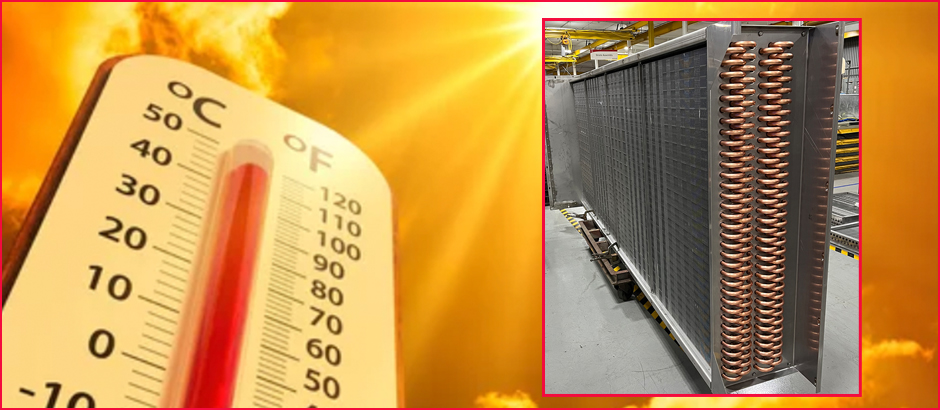
Turbine inlet cooling coils (as well as turbine inlet heating coils) are not ordinary commercial or industrial coils, and are not offered by all coil manufacturers. At Marlo, we specialize in these unique, custom coils, which are typically much larger that traditional heating and cooling coils – commonly up to 30 feet long and 8 feet tall. We’ve designed and built coils to treat air entering gas turbines ranging from 20 MW to over 500 MW. Marlo turbine coils are approved by all major gas turbine OEMs, are installed at power plants around the world, and have proven their performance, durability and reliability for many years under very extreme conditions.
The benefits extend beyond summer. Marlo also builds turbine inlet heating coils that reduce the risk of icing and improve efficiency during turndown operation, a mode that is increasingly common as more wind and solar are added to the grid. Depending on the application, Marlo turbine inlet coils can help increase power output, eliminate icing, minimize pressure drop, boost efficiency and improve reliability.
The Success of the Power Grid Could Rely on Inlet Cooling Coils
We design and build coils to the precise circuiting, fin spacing, and dimensional tolerances that sensitive process applications require, working from customer performance data rather than a generic catalog selection. Our state-of-the art manufacturing facility utilizes the latest automated technology to deliver maximum precision in every cut, bend and weld.
At Marlo, we’re ready to help meet this challenge. To discuss your turbine cooling needs, reach out to our team, or contact your local Marlo representative.
Email Registration
Please complete the form below to sign up for our Marlo Messenger newsletter and other email communications.
"*" indicates required fields