
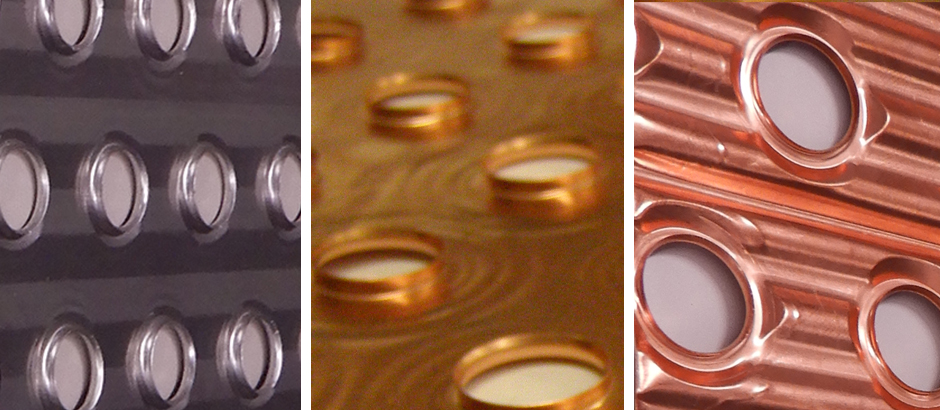
Of all the components that make up a commercial or industrial heating or cooling coil – whether it’s a hot water coil, steam coil, chilled water coil, dampered face and bypass coil (our Stratomizer), or any other type of coil – the fins are one of the most critical. These thin metal sheets, which can be made of a variety of different metals, are attached perpendicular to the coil’s tubes, driving the heat transfer process as air blows through them.
Fins dramatically increase the external surface area exposed to airflow, accounting for 65-70% of the total heat transfer in most coils. A variety of factors go into choosing the type of fin, as well as the type and thickness of the fin material, depending on the specific coil application. These factors are discussed in detail below.
Choosing the Fin Type
At Marlo, we offer three distinct types of fins, each with different advantages and potential drawbacks. As always, the choice will depend on the specific requirements of your particular application.
Turbex (Sine Wave) Fin
The most common type of fin in the industry, a sine wave fin features the most dramatic wave pattern. This design creates the greatest air turbulence, providing the highest heat transfer efficiency. However, the increased wave pattern increases air pressure drop, and is also considerably more difficult to clean since debris can become trapped in the deepest parts of the waves.
Flat Fin
A flat fin surface minimizes air turbulence flowing through the coil, resulting in the lowest air pressure drop – but also a lower heat transfer capability. An important benefit of flat fins is that they are much easier to clean, and are far less likely to collect dust and debris.
“M” Fin
Marlo’s M fin was developed to balance out the advantages and disadvantages of the Turbex and flat fins. The M fin is designed with a wave pattern that is less pronounced than that of the Turbex fin, but obviously more of a wave that a flat fin. As a result, the M fin offers a balance between high heat transfer efficiency and low air pressure drop. It also offers a middle ground with regard to debris build-up and cleaning.
Choosing Fin Material and Thickness
Fins are most commonly made of aluminum, but are also available in other materials depending on the application. As with the fin type, each material (and thickness) comes with benefits and drawbacks, as described below.
Aluminum Fins
From a material standpoint, aluminum remains the overwhelming default due of its excellent thermal conductivity and low cost. At Marlo, our standard aluminum fins are .010” thick, which is 33% greater than the .0075” aluminum used by many other manufacturers. While aluminum fins are the obvious choice for the majority of commercial applications, certain industrial and corrosive environments require fins made of more durable metals.
Copper Fins
When additional heat transfer capability and/or increased durability is required, copper is an ideal choice – despite its increased cost. Our copper fins are typically also .010” thick, and can be as thick as .020” for heavy duty applications. In addition, copper has anti-microbial properties that are critical in certain clean environments, such as in food processing plants.
Stainless Steel Fins
For special applications, high temperatures and corrosive environments, stainless steel fins are often required, due to their excellent durability and resistance to corrosion. However, the tradeoff for this stronger material is increased costs and reduced heat transfer compared to both aluminum and copper. Stainless steel fins are often chosen for pharmaceutical and chemical plants, as well as applications with frequent wash-down using harsh chemicals. In addition, stainless steel has a much higher melting point than aluminum, so it can be used in processes that operate at higher temperatures, such as waste heat recovery, or thermal processes.
Steel Fins
For high temperature applications, or those where the environment isn’t compatible with aluminum or copper, steel fins can often offer a reliable, but less expensive option than stainless steel. In addition, steel fins can be galvanized or nickel plated to withstand harsh environments where traditional coils would not survive, prolonging coil life.
Superior Fin Construction
No matter the selections for fin type, material and thickness, the performance and durability of a coil’s fins (and ultimately of the coil) are dependent on how the fins are manufactured. At Marlo, our state-of-the-art equipment and quality control processes assure that our fins are built to the highest possible standards.
We perform regular maintenance on our fin dies to assure that the tolerance of the hole sizes and locations are extremely precise. That means the tubes insert uniformly through the holes during production, resulting in a strong bond after hydrostatic expansion into the fins – for maximum heat transfer and the highest performance in the field.
In addition, Marlo takes the extra step of using extruded holes in our fins, which are formed by a die that raises a collar around the hole. This very precise collar accurately sets fin spacing, ensuring that the coil has the specified number of fins per inch, which guarantees the performance of the coil.
The Fin Choices You Need – and the Help You Need to Make Them
At Marlo, we offer a wide range of fin types, materials and thicknesses to assure that we can meet virtually any need. Plus, our MarloMetrics coil selection software makes it easy for us – or any of our Independent Manufacturer’s Representatives (IMRs) – to make the choices that are best for your application.
Whatever is most important to you – heat transfer, pressure drop, corrosion resistance, cost, or any other factor – the MarloMetrics software will compare all variables and determine the best solution, while guaranteeing the performance of the coil, including the predicted air pressure drop.
Contact your local Marlo IMR to get a replacement coil you can count on to meet all of your needs, whether it’s a standard heating or cooling coil, or a specialized industrial process coil in the most demanding environment. To locate a local Marlo representative in your area, just search by zip code using our rep locator.
Email Registration
Please complete the form below to sign up for our Marlo Messenger newsletter and other email communications.
"*" indicates required fields