
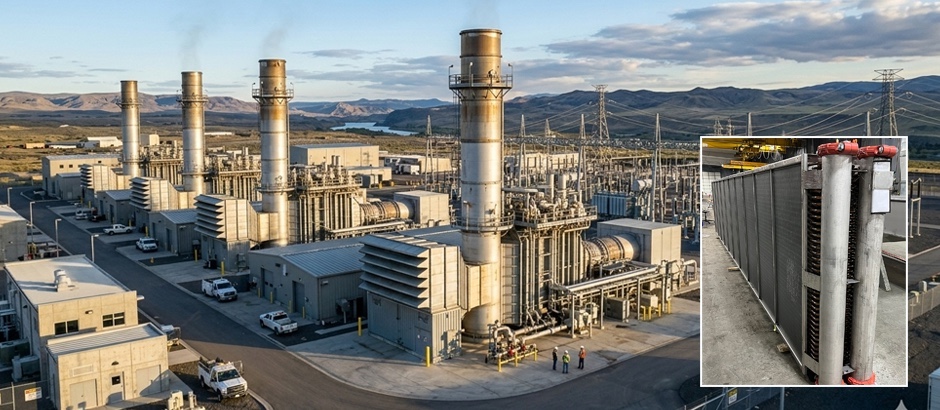
The rapid growth of artificial intelligence, cloud computing, cryptocurrency, streaming platforms, and other data-intensive applications are driving the massive growth in data centers, which is transforming the global electricity landscape. Data centers are no longer a niche segment of the economy – they are critical infrastructure that require vast amounts of reliable, around-the-clock power.
As electricity demand accelerates, especially in regions experiencing explosive data center development, utilities and independent power producers are facing a clear challenge: how to generate more dependable megawatts (MW) – quickly and efficiently.
While renewable and other energy sources will contribute to meeting the needs, gas-fired power plants will remain a key part of the solution. And one of the most effective ways to unlock additional power output from existing gas turbine facilities is through turbine inlet cooling (TIC) using high-performance cooling coils – a Marlo specialty.
The Data Center Demand Surge
Data centers consume enormous amounts of electricity – not just to power servers, but also to cool them. Hyperscale facilities can demand over 100 MW each, and large regional clusters can rival the electrical consumption of small cities. Several trends are accelerating this demand:
- Growth of AI models/usage
- Cloud computing expansion
- Edge computing
- Electrification of infrastructure
- 24/7 uptime requirements
Unlike many other loads, data centers require consistent, high-reliability baseload power. Intermittent sources alone cannot meet this need without extensive storage infrastructure. As a result, gas-fired generation remains essential in many markets.
Why Gas Turbines Lose Power in Hot Weather
Most gas turbines operate at peak efficiency when incoming air temperatures are around 60 degrees Fahrenheit. So, it is common for gas turbines to lose 10-20% of rated capacity during hot summer conditions – precisely when electricity demand is at its peak. For power producers supplying data centers, this seasonal loss presents a serious challenge that must be overcome if data center demands are going to be met.
Gas turbines are air-breathing machines. Their power output depends directly on the mass of air entering the compressor. The key principle is this: Hot air is less dense than cool air. The impact of this fact is that when ambient air temperatures rise:
- Air density decreases
- Oxygen mass entering the compressor decreases
- Combustion efficiency drops
- Power output declines
Most gas turbines operate at peak efficiency when incoming air temperatures are around 60 degrees Fahrenheit. So, it is common for gas turbines to lose 10-20% of rated capacity during hot summer conditions – precisely when electricity demand is at its peak. For power producers supplying data centers, this seasonal loss presents a serious challenge that must be overcome if data center demands are going to be met.
The Solution: Turbine Inlet Cooling (TIC)
Turbine inlet cooling systems reduce the temperature of the air entering the gas turbine compressor. By lowering inlet air temperature, a chain reaction of positive outcomes occurs:
- Air density increases
- Mass flow rate increases
- Combustion efficiency is improved
- Turbine power output is boosted
- More megawatts of power are generated from the same turbine
Turbine Inlet Cooling Coils are Typically the Best Option
While there are other ways to cool the air entering a turbine, such as with water mist, these systems require large amounts of very clean water – which is not always a practical solution. Turbine inlet cooling coils using chilled water, however, offer an efficient closed-loop cooling system to bring inlet air temperatures down and drive power output up.
When ambient air passes over the turbine inlet cooling coils, the temperature of the air entering the turbines drops, which increases the air density. As a result, the gas turbine air compressor ingests a greater mass of air, allowing it to burn fuel more efficiently and generate more power.
Depending on conditions, turbine inlet cooling coils can increase power output by 10-20% during the warmer months, allowing power plants to recover lost summer capacity and improve peak-hour revenues. Plus, this increase in output can reduce or eliminate the need for extra power generation assets. For plants supporting data center load growth, this added capacity – without the expense of adding turbines – is a critical and extremely cost-effective solution.
For a Job this Important, Trust the Turbine Coil Experts
At Marlo, we’ve specialized in designing and building turbine inlet cooling coils (as well as turbine inlet heating coils for certain applications) for many years, and have provided coils for turbines ranging from 20MW to over 500MW at power plants around the world. That’s why our turbine inlet cooling coils have been approved by all the major gas turbine manufacturers.
These coils are typically significantly larger than “standard” commercial/industrial coils – often measuring 20-30 feet long and 8-10 feet tall. So not every coil manufacturer is able to meet these size demands. In addition to their extreme size, turbine coils must also offer extreme performance. This includes high heat transfer efficiency, reliable structural durability, and long service life – usually in demanding and often corrosive outdoor environments.
At Marlo, our engineered turbine inlet cooling coil solutions are designed to meet these demanding requirements, offering a number of important advantages:
- Proven coil designs, based on years of experience, that maximize thermal performance
- Custom fin spacing for optimal airflow and minimal pressure drop
- Built with a range of materials, selected for durability and corrosion resistance to meet the needs of each individual application
- Precision fabrication in a state-of-the-art facility, assuring both performance and reliability
Final Thoughts
There’s just no question about it: The rapid expansion of data centers is reshaping global energy demand, and gas-fired power plants remain a crucial component of overall energy production. So, maximizing the power output of gas turbines – especially in warm weather – is more important than ever.
Fortunately, Marlo has the experience and ability to help meet these critical power needs with our turbine inlet cooling coils. They are a practical, proven, efficient way to:
- Reduce air temperatures entering the turbines
- Increase megawatt output
- Improve summer performance
- Support growing digital infrastructure
- Enhance plant profitability
As the world’s appetite for data continues to grow, so must the power that supports it.
For more information about engineered cooling coil solutions for turbine inlet cooling applications, visit our turbine inlet coils page, and contact us or your local Marlo representative to learn more.
Email Registration
Please complete the form below to sign up for our Marlo Messenger newsletter and other email communications.
"*" indicates required fields